|
DMH Spotlight
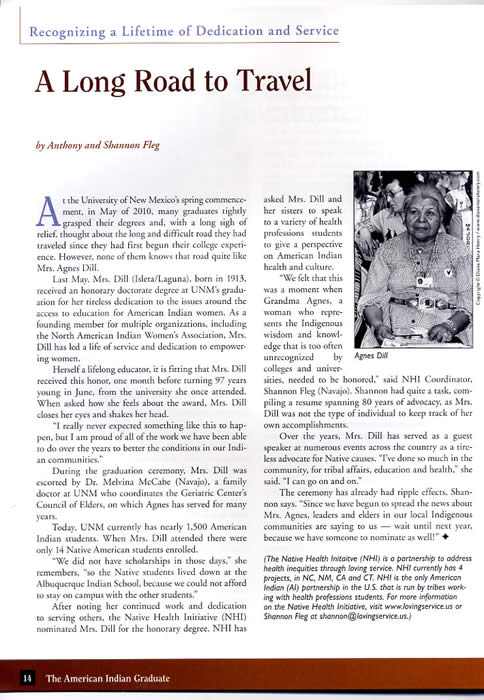
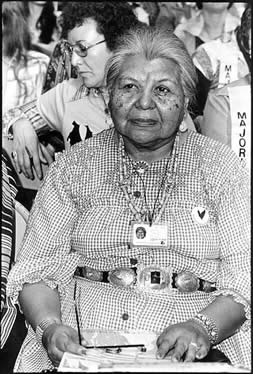
Women on the Move: Participate in the Resurvey of the Houston 1977 First National Women's Conference. See yourself there! Take the Survey! Read Lucy Komisar's report for the Nation two weeks after the event! Hear from Suzy Chaffee! Learn about delegates Agnes Dill and Vanessa Oruska. Read analysis by Sabra Ferguson. |
Back |
Pitch in and help support Houston 35th Anniversary Celebrating Women exhibit
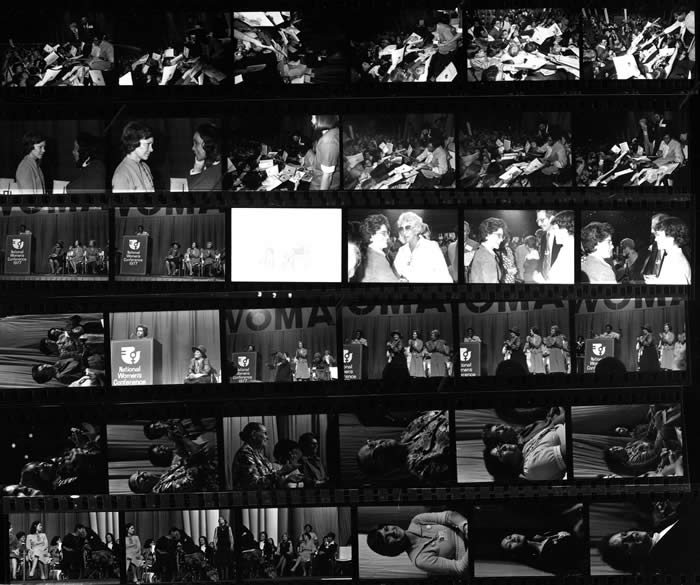
CLICK HERE FOR ENLARGEMENT VIEWING
(See the opposition to the Conference from Phyllis Schlafly and the Citizen's Review Committee here)
"Diana…I was a delegate at the 1977 National Women’s Convention and I am in one of your photos online.
I am on the bottom row, third from right. My name then was Arceneaux....I was a delegate from Louisiana. Yes, I saw your article and am in the process of answering your questionnaire. I was tickled to see the other 16 year old from the Convention. I don’t think there were many of us that were that young and participating...
All the best…Dottie Arceneaux...." January 17, 2012
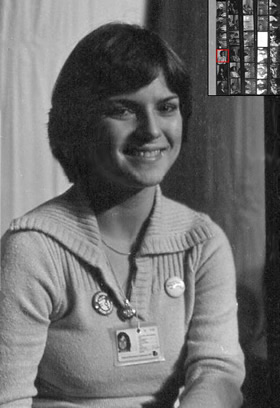
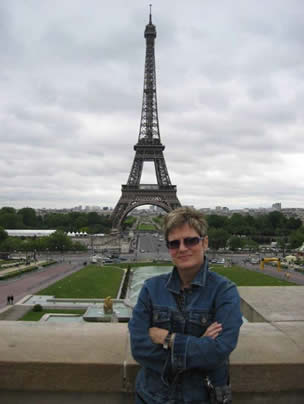
Read Dottie's responses to our questionnaire here
Thank you, Dottie!
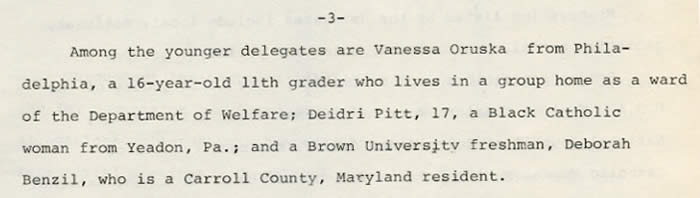
Please scroll down for Vanessa Oruska's story, and here is another teenage delegate with her chaperone
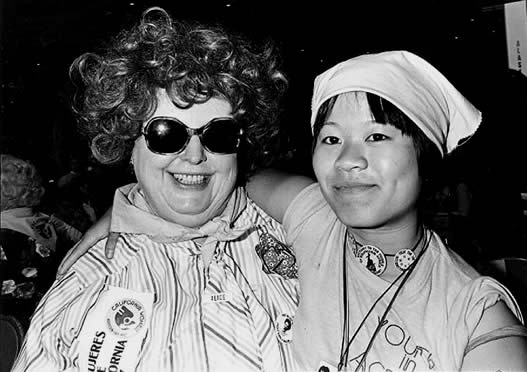
Alice Wong and Colleen Bibeau, California Delegates to the First National Women's Conference, 1977
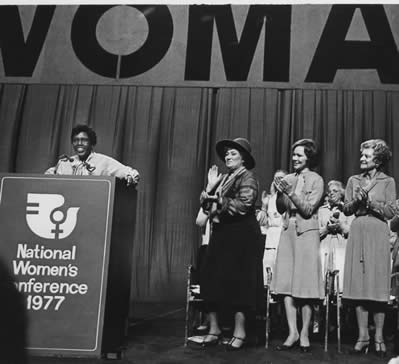
[In the above contact sheet - #2 from DMH - can also be seen; top and second row: Congresswoman Barbara Jordan signing autographs, giving the keynote address; Congrewwoman Liz Holtzman with Ersa Poston of the US civil Service Commission and Sey Chassler, editor of Redbook magazine; third row: Bella Abzug, Rosalyn Carter and Betty Ford applauding Barbara Jordan;second to last row: Dignitaries on stage including Clara Beyer ( below, in another frame from another conatct sheet) ; bottom row: Lynda Johnson Robb and other delegates such as Sharon Percy, third from right, Mariko Tse, "24 years old, from California, leader of Chinese Women in Action, world traveler, graduate in anthropology, leader in Upward Bound programs for Blacks, Chicanas, Indians and the American Chinese" and Marianne Brusselhoffe, "who was putting three of her four children through college by raising poultry." (quoted passages from The Spirit of Houston: The First National Women's Conference: An Official Report to the President, the Congress and the People of the United States)]
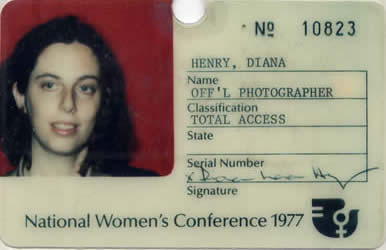
All 42 contact sheets of photographs from the First National Women's Conference by its official photographer, Diana Mara Henry, can be on line at nationalwomensconference.org and linked from here. On that site, you could scroll through the images and enlarge them many times. Perhaps you will recognize yourself or someone you know. Then you can Email us with the sheet number and frame number and identify the person. Here are the captions we already have for the photographs.
Through the NY Foundation for the Arts -NYFA's fiscal sponsorship program, ARTSPIRE, you can sponsor the scanning of these images and ephemera! In the meantime, you can participate in our resurvey of the women participants of the Houston IWY conference, 1977!
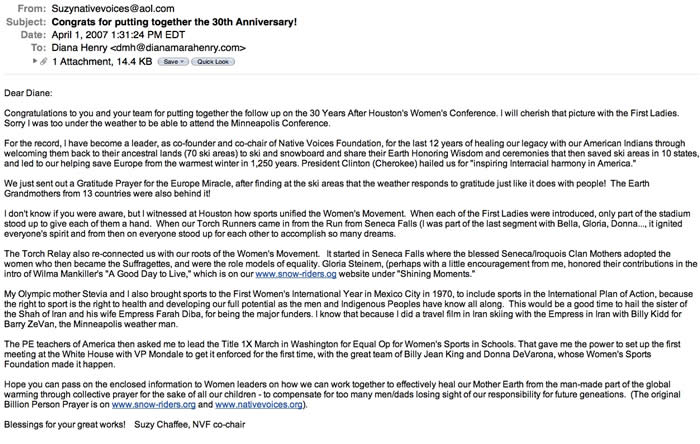
"Blessings for your great works!" Suzy Chaffee, 4/1/07
"I'm glad you're doing this." - Eleanor Smeal, Feminist Majority Foundation, 3/8/11
Read a contemporary eye-witness analysis:
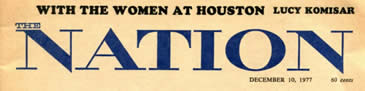
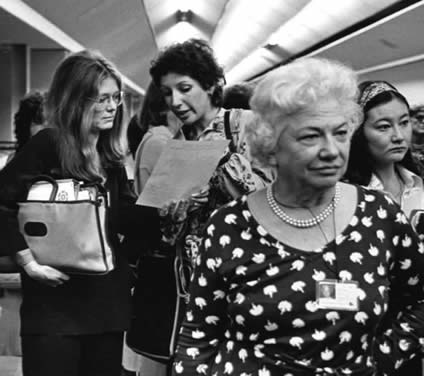
Lucy Komisar, second from left, below, with Gloria Steinem, Liz Carpenter, and Rita Elway.
For the full story by Lucy Komisar about Houston in The Nation, December 10, 1977, see The Komisar Scoop
Read a 2011 analysis of the conference by Sabra Ferguson for her course in Texas Women's History taught by Professor Elizabeth Snapp
See a description of the Resurvey, below. Get a copy of the questionnaire.
Please contact us with support funding for this exciting project. Thank you.
[In the above contact sheet - #2 from DMH - can be seen; top and second row: Congresswoman Barbara Jordan signing autographs, giving the keynote address; Congrewwoman Liz Holtzman with Ersa Poston of the US civil Service Commission and Sey Chassler, editor of Redbook magazine; third row: Bella Abzug, Rosalyn Carter and Betty Ford applauding Barbara Jordan;second to last row: Dignitaries on stage including Clara Beyer ( below, in another frame from another conatct sheet) ; bottom row: Lynda Johnson Robb and other delegates such as Sharon Percy, third from right, Mariko Tse, "24 years old, from California, leader of Chinese Women in Action, world traveler, graduate in anthropology, leader in Upward Bound programs for Blacks, Chicanas, Indians and the American Chinese" and Marianne Brusselhoffe, "who was putting three of her four children through college by raising poultry." (quoted passages from The Spirit of Houston: The First National Women's Conference: An Official Report to the President, the Congress and the People of the United States)] CLICK HERE FOR ENLARGEMENT VIEWING
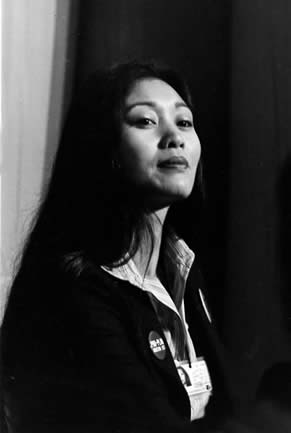
Right: Mariko Tse
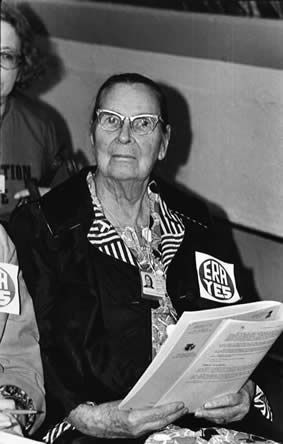
Left: Clara Beyer, oldest delegate to the First National Women's Conference.
See Clara Beyer's obituary in the NY Times:
"Clara Beyer, 98, Dies; Key New Deal Official
Published: September 28, 1990
LEAD: Clara Beyer, an influential New Deal administrator who served as a confidential aide to Frances Perkins during her 12 years as Secretary of Labor, died Tuesday at her home in Washington. She was 98 years old.
Clara Beyer, an influential New Deal administrator who served as a confidential aide to Frances Perkins during her 12 years as Secretary of Labor, died Tuesday at her home in Washington. She was 98 years old.
A family spokesman said she died of a heart ailment.
A forceful, dynamic woman, Mrs. Beyer became a close friend of Secretary Perkins and Eleanor Roosevelt. She is credited by Esther Peterson, a former Presidential adviser on consumer affairs, with bringing diverse state labor laws under a common Federal umbrella.
Mrs. Beyer began her career as secretary of the Minimum Wage Board for the District of Columbia after World War I. Her job was to assess the wages paid to women in the district so minimum levels could be set.
In 1928 she went to work for the Children's Bureau of the Labor Department. After Franklin D. Roosevelt's election as President, she played a valuable back-room role in the appointment of Secretary Perkins, the first woman ever named to a Cabinet, and in the development of much of the social legislation that marked the New Deal: establishing worker safety, maximum hours, minimum wages and Social Security."
[ Ms. Beyer is in the second, third and fourth frames from left, row one up from bottom.]
Women on the Move
Fourth Decade Follow-Up Survey and Oral History of the Legacy
of the First National Women’s Conference
Concept and Photographs by Diana Mara Henry
In the thirty plus years since the First National Women’s Conference brought women to Houston in November 1977, what have these activists continued to do for themselves and others? How do they articulate the aspirations they brought as delegates to the conference, honored speakers, staff or Commissioners of the President’s Commission on International Women’s Year? What were their goals then and have they been able to realize these goals? What did the conference bring to their lives in terms of connections made and lessons learned? Have these women stayed active in the public arena? Have their positions on the issues changed? Where are they now?
The last question is the key to the success of this study: but the search for these ”20,000 women, men and children” who were there (according to the official report, The Spirit of Houston) will in itself create interest, discussion, and reawakening of the commitments and ideals of what may be considered the crowning event of Second Wave Feminism.
Many of the delegates went on to do great things: Ann Richards had just won her first election, to become the first female commissioner of Travis County; 13 years later, she would be elected Governor of Texas. Claire Shulman became the First Borough President of Queens. Mariko Tse pursued a career in film. Three Presidents’ wives were there; Betty Ford went on to become a distinguished advocate for others suffering from alcohol and substance abut and to found treatment centers to minister to their needs.
What of the other hundred of delegates, some as young as 17, such as Colleen Wong, of California? The nuns, the farm women, the welfare rights mothers, the sexual preference advocates? What did they go on to do with their lives? Did the conference serve as an inspiration and in what way? Have they stayed in touch and worked with others who were there?
After more than 30 years, while some of the leaders sadly are gone (Bella Abzug, Barbara Jordan, Patsy Mink) the women of the rank and file have now assumed their role in history, and their contributions to family, community and country can be ascertained. All we need to do is find them- and that, with the help of the Internet, can also be done. State by state, the delegate lists can be researched and contacts established.
Diana Henry has been in touch with some, such as one of the Last mile’s torch bearers, Peggy Kokernot (now Kaplan) who ran marathons as a US Marine and has become an animal rights activist; Chief Pulu Peneueta, of American Samoa, whose family has established a website honoring her memory, the conference coordinator, Lee (now Rabbi Leah) Novick, and Liz Carpenter, who continues to cheer on and support her with wit and wisdom.
We can put the contact sheets of more than 1,200 images made of them by the Conference’s official photographer online, and ask them to identify themselves therein.
We can ask them how they came to be at the Conference, and to tell us what they experienced and accomplished there. We can ask them to send us a photograph representing their role and/or interests and participation in family or community since 1977. We can ask them to describe what they have done since, whether their values have changed or become more focused, and what role their participation in the conference played in their life’s story. What will emerge will be as diverse and inspiring as the conference in its day, and hopefully keep us on the mission Maya Angelou penned – “To Form a More Perfect Union.”
What can result of this search? A book, a funded website, an exhibit, another National Women’s Conference? With the national scope of this project anything is possible, and with your help, interest, and participation, it will be done.
Diana Henry 188 Sumner Avenue, Springfield, MA 01108 413-736-6414
Alice Rossi's 1978 survey found a high level of post-conference activity among Houston delegates when they returned home: fully 86 percent gave at least one talk about the conference, 60 percent were interviewed in a local paper, and 52 percent appeared on a local radio or television show.[47] The historical significance of the Conference still resonated. Rossi argued that:
"...those who participate in social movements are likely to have sensitive appreciation of landmark events in their own history. Indeed, one empirical indicator of the vitality of a social movement may be the level of awareness and agreement among members concerning highpoint dates and events in its own history. ...Major events like Seneca Falls, the ratification of suffrage, the founding of NOW, the Supreme Court decision on abortion, and perhaps the Houston national conference, help to shape and affirm a consciousness of one's own significance in history."[Rossi, Feminists in Politics, p. 323.]
Thank you, Vanessa Oruska!
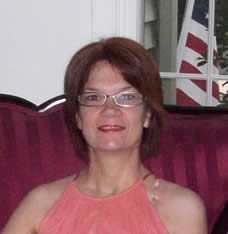
Vanessa Oruska, Pennsylvania delegate, was 16 in 1977! She answered the questionnaire, 2/14/2011:
• Your name, address, phone, email and URL : Vanessa Oruska - 267-330-3369
• What was your name and address at the time of the FNWC? : Same as above
• What was your occupation, age and schooling at that time? : I was a student, age 16
• Were you a delegate or in what other way were you involved in the conference? : I was a PA delegate
• Did you attend a State Meeting prior to attending the conference, and if so, which one? : I don't remember
• Do you have ephemera (fliers, buttons, schedules, articles) from the meeting or the conference? If you have donated them or otherwise disposed of them, please tell us how. : I do not have any memorabilia
• Did you write about the meeting and/or conference and or photograph/film it and do you still have those writings/photographs/films? Do you have any intentions of placing those materials in an archive and if so, which one? : NO
• Please share with us why you attended the FNWC and state meeting. : Not sure why- I was in a program
• Please share what you experienced there. : I met C. Delores Tucker, Coretta Scott King, Barbara Jordan
• Please share your use of what you learned/did at the conference in future years:: I went on to campaign for C. Delores Tucker.
• What was your subsequent schooling/reading/research? Did the FNWC impact that in any ways? N/A
• What has been your career path or paths? Did the FNWC impact that in any ways? : NO
• What was your family configuration in 1977 and how did that change until now? Did the FNWC impact that in any ways? : I was in a foster home in 1977
• What was your work situation in 1977 and how did that change until now? Did the FNWC impact that in any ways? : I was working for Teen-Aid, Big Sister Big Brother program part time.
• What were your civic/philanthropic/volunteer paths then and how did they change until now? Did the FNWC impact that in any ways? N/A
• Could you share a photograph with us of who you are today, either with family, in work setting, leisure occupation or any other representation of you? I will get back to you on the picture
• Would you like to see another Women’s Conference on the scale of Houston, 1977 and do you think State Meetings would be a necessary component? Who should sponsor/fund such a conference?
• What part(s) of the Plan of Action concerned you most in 1977 and what issues would be most important for you to see voted on today?
• Has your political, religious, gender affiliation changed since 1977 and in what way? Did the FNWC impact that in any ways?
• Are there any other changes in your life path that were or were not attributable to your experience at Houston that you would like to share?
• Could you share a perspective on the women’s movement then, now and a recommendation on women’s issues for young women today?
• Please share anything else with us not covered in these questions that you think is important to you or others.
23. May we publish your answers, along with others, on this website? : YES
Thank you very much. Diana Mara Henry
188 Sumner Avenue, Springfield, MA 01108 413-736-6414 dmh@dianamarahenry.com
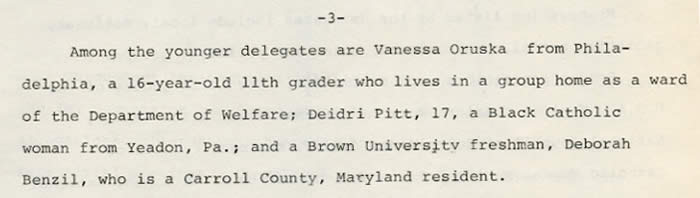
Please "get with the program," join Vanessa, answer the questionnaire, and let's keep the conversation going!
Photograph of Agnes Dill at the First National Women's Conference, Copyright © 1977 Diana Mara Henry.
Send us your photos and clipping, please!
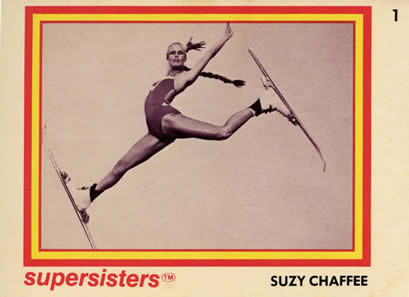
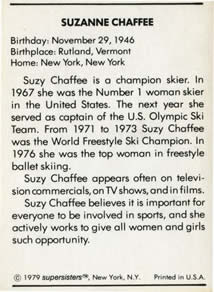
Suzanne "Suzy" Chaffee (born November 29, 1946, Rutland, Vermont) is a former Olympic alpine ski racer and actress. Following her racing career, she modelled in New York with Ford Models and then became the pre-eminent freestyle ballet skier of the early 1970s....As a social activist, Chaffee championed Title IX legislation (equal opportunity for women in school sports). She was the first woman to serve on the board of the U.S. Olympic Committee, and has been a member of the President's Council on Physical Fitness under four U.S. presidents. She was a co-founder in 1996 of the Native Voices Foundation, an organization that seeks to develop Olympians from among Native American tribes.[from Wikipedia] She is one of a widening circle of Houston "alums" who are coming together on this website...We need you too!
Back to home page of www.dianamarahenry.com Back to Spotlight home page Or, email us now! Thank you!